The Python data ecosystem has been dominated by pandas for over a decade. It is the default import for data manipulation, the first library taught in bootcamps, and the backbone of countless production pipelines. But pandas was designed in 2008 for a different era — single-threaded, memory-hungry, and increasingly unable to keep pace with modern dataset sizes. A new library has emerged that rethinks DataFrames from the ground up: Polars.
This article explains what Polars is, why it is gaining rapid adoption among data engineers, and how MigryX enables organizations to migrate legacy codebases directly to idiomatic Polars — skipping the pandas middle ground entirely.
What Is Polars?
Polars is an open-source DataFrame library built from scratch in Rust on top of Apache Arrow. Released under the MIT license, it describes itself as "DataFrames for the new era" — and the claim is not hyperbole. Unlike pandas, which was written in Python with NumPy underpinnings, Polars was designed from the start for performance, memory efficiency, and modern hardware.
The core engine is written entirely in Rust, a systems programming language known for memory safety without garbage collection. This gives Polars predictable performance characteristics, zero-copy data sharing, and the ability to leverage every CPU core on the machine without fighting Python's Global Interpreter Lock (GIL). The Python API is a thin wrapper over this Rust engine — when you call a Polars function, execution drops into compiled Rust code immediately.
Apache Arrow provides the memory format. Instead of pandas' fragmented internal representations (NumPy arrays, Python objects, categorical codes), Polars stores all data in Arrow's columnar format. This means zero-copy interoperability with other Arrow-native tools — DuckDB, DataFusion, Flight — and a memory layout that modern CPUs can process efficiently through cache-friendly sequential access patterns.

Polars — enterprise migration powered by MigryX
Why Polars Over pandas?
The limitations of pandas are well-documented, but they are worth reviewing because they explain why Polars exists and what it solves.
Memory efficiency. pandas uses a row-oriented memory model inherited from NumPy. A DataFrame with mixed column types stores each column as a separate NumPy array, but operations frequently create full copies. A common pandas workflow can consume 5-10x the size of the underlying data in peak memory. Polars uses Arrow's columnar format with zero-copy slicing, reference counting, and memory-mapped I/O. The same workflow typically uses 2-3x less memory than pandas.
Multi-threaded execution. pandas operations are single-threaded by design. Even on a 64-core machine, a groupby().agg() call uses exactly one core. Polars automatically parallelizes operations across all available cores. A group-by aggregation on a 32-core machine can be 20-30x faster purely from parallelism, before accounting for algorithmic improvements.
Lazy evaluation with query optimization. pandas evaluates every operation eagerly — each line of code executes immediately, even if intermediate results are never used. Polars offers a LazyFrame API that builds a logical query plan and optimizes it before execution. The optimizer applies predicate pushdown (filtering early), projection pruning (dropping unused columns), and common subexpression elimination. This is the same class of optimization that SQL databases have used for decades, now applied to DataFrame operations.
Type safety. pandas is permissive about types to a fault. A column can silently contain mixed types, NaN values coerce integers to floats, and datetime handling varies by dtype. Polars enforces strict typing based on Arrow's type system. An integer column is always an integer. Null values do not change the column type. This eliminates an entire category of subtle bugs that plague pandas pipelines in production.
No GIL limitation. Python's Global Interpreter Lock prevents true multi-threaded execution of Python bytecode. Libraries that call into C extensions (like NumPy) can release the GIL for specific operations, but pandas' Python-level code remains single-threaded. Because Polars' engine is pure Rust, it never holds the GIL during computation. The Python layer is only involved in constructing the query plan, not executing it.
MigryX: Idiomatic Code, Not Line-by-Line Translation
The difference between MigryX and manual migration is not just speed — it is code quality. MigryX generates idiomatic, platform-optimized code that leverages native features of your target platform. A SAS DATA step does not become a clunky row-by-row loop — it becomes a clean, vectorized DataFrame operation. A PROC SQL query does not become a literal translation — it becomes an optimized query that takes advantage of your platform’s pushdown capabilities.
Key Features
Polars is not simply a faster pandas. It introduces concepts and APIs that enable fundamentally different data engineering patterns.
LazyFrame and Query Optimization
The LazyFrame is Polars' most powerful concept. Instead of executing operations immediately, a LazyFrame builds a directed acyclic graph (DAG) of operations. When you call .collect(), the optimizer rewrites this DAG before execution. Key optimizations include:
- Predicate pushdown — filters are pushed as close to the data source as possible, reducing the amount of data read from disk or memory.
- Projection pruning — columns that are never used in the final result are dropped early, reducing memory consumption throughout the pipeline.
- Common subexpression elimination — repeated computations are identified and executed only once.
- Join reordering — the optimizer can reorder joins to minimize intermediate result sizes.
Expression API
Polars' expression API is designed for composability and readability. Instead of pandas' mix of bracket indexing, .apply(), and method chaining, Polars uses a consistent expression system built around pl.col(), .with_columns(), and .group_by().agg(). Expressions are column-level operations that can be combined, nested, and reused.
import polars as pl

result = (
    pl.scan_parquet("sales.parquet")
    .filter(pl.col("region") == "WEST")
    .with_columns(
        (pl.col("revenue") - pl.col("cost")).alias("profit"),
        pl.col("date").dt.quarter().alias("quarter")
    )
    .group_by("quarter")
    .agg(
        pl.col("profit").sum().alias("total_profit"),
        pl.col("order_id").n_unique().alias("unique_orders")
    )
    .sort("quarter")
    .collect()
)
Polars SQL
For teams transitioning from SQL-heavy environments, Polars includes a built-in SQL engine. You can register DataFrames as tables and query them with standard SQL syntax. This bridges the gap for analysts who are fluent in SQL but new to the expression API.
Streaming for Larger-Than-Memory Datasets
Polars' streaming engine processes data in batches, enabling operations on datasets that exceed available RAM. By calling .collect(streaming=True) on a LazyFrame, Polars processes the query plan in chunks rather than materializing the entire dataset in memory. This extends Polars' effective reach from "fits in memory" to "fits on disk."
Plugin System
Polars supports custom expression plugins written in Rust, allowing organizations to extend the engine with domain-specific operations that execute at native speed within the query plan. This means specialized business logic — custom string matching, proprietary scoring algorithms, domain-specific aggregations — can run inside the Polars engine rather than falling back to slow Python callbacks.
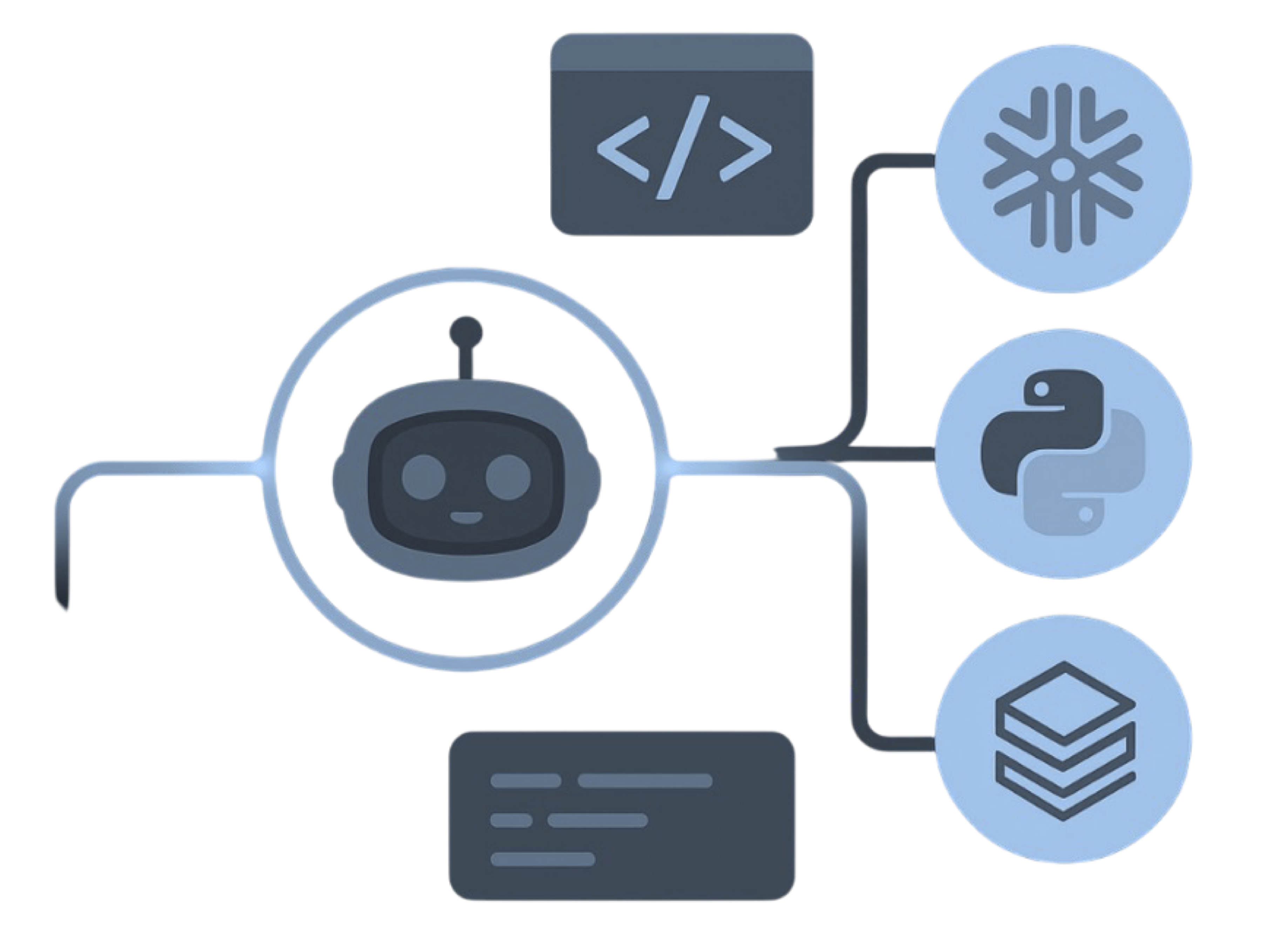
MigryX precision parser — Deep AST-level analysis ensures every construct is understood before conversion begins
Platform-Specific Optimization by MigryX
MigryX maintains deep knowledge of every target platform’s strengths and best practices. When converting to Snowflake, it leverages Snowpark and native SQL functions. When targeting Databricks, it uses PySpark DataFrame operations optimized for distributed execution. When generating dbt models, it follows dbt best practices for modularity and testability. This platform awareness is what makes MigryX output production-ready from day one.
Performance Benchmarks
Performance claims require evidence. The most widely cited benchmarks come from the TPC-H suite, a standard set of analytical queries used to evaluate database and DataFrame library performance. On the TPC-H benchmarks, Polars consistently outperforms pandas by 10-50x depending on query complexity, dataset size, and hardware. For aggregation-heavy queries, the gap widens further due to Polars' multi-threaded execution.
The performance advantage is not just about speed — memory consumption tells an equally important story. Polars' Arrow-based memory model typically uses 50-70% less RAM than pandas for equivalent operations, which means larger datasets can be processed on the same hardware.
| Feature | pandas | PySpark | Polars |
|---|---|---|---|
| Execution model | Eager, single-threaded | Lazy, distributed | Lazy + eager, multi-threaded |
| Memory format | NumPy arrays (row-oriented) | JVM + Arrow (Spark 3.x) | Apache Arrow (columnar) |
| Parallelism | None (GIL-bound) | Cluster-level (multi-node) | CPU-level (all cores) |
| Query optimizer | None | Catalyst optimizer | Built-in lazy optimizer |
| Dependency | NumPy, Python | JVM, Spark cluster, Hadoop | Rust binary only |
When to Choose Polars
Polars is not a universal replacement for every data processing tool, but it occupies a sweet spot that is surprisingly large.
Single-machine analytics. If your data fits on one machine (up to ~100GB on modern hardware with streaming), Polars will outperform pandas by an order of magnitude and match or exceed PySpark without the overhead of a Spark cluster.
Data preparation and feature engineering. ETL pipelines that clean, transform, and aggregate data before loading into a warehouse or ML model are ideal Polars workloads. The lazy evaluation engine optimizes the entire pipeline as a single query plan.
Replacing pandas in production. Production pandas pipelines that have grown slow, memory-hungry, or unreliable are prime candidates. Polars' strict typing and predictable performance characteristics make it more suitable for production workloads than pandas.
Speed without cluster overhead. Organizations that need PySpark-class performance but cannot justify the infrastructure complexity of a Spark cluster can use Polars to achieve similar throughput on a single, well-provisioned machine.
MigryX + Polars
MigryX converts legacy SAS, Alteryx, and DataStage pipelines directly to Polars LazyFrame code — generating idiomatic expressions, proper lazy evaluation chains, and Arrow-native I/O — so you can skip the pandas middle ground entirely.
The DataFrame landscape is shifting. pandas established the category and remains widely used, but Polars represents the next generation — built on modern foundations, designed for modern hardware, and optimized for the scale of modern data. For organizations planning migrations from legacy platforms, targeting Polars from the start means building on a foundation that will scale with their data for years to come.
Why MigryX Delivers Superior Migration Results
The challenges described throughout this article are exactly what MigryX was built to solve. Here is how MigryX transforms this process:
- Production-ready output: MigryX generates code that passes code review and runs in production — not prototype-quality output that needs weeks of cleanup.
- Platform optimization: Converted code leverages target platform-specific features for maximum performance and cost efficiency.
- 25+ source technologies: Whether migrating from SAS, Informatica, DataStage, SSIS, or any of 25+ legacy technologies, MigryX handles it.
- Automated documentation: Every conversion decision is documented with before/after code mappings and transformation rationale.
MigryX combines precision AST parsing with Merlin AI to deliver 99% accurate, production-ready migration — turning what used to be a multi-year manual effort into a streamlined, validated process. See it in action.
Ready to build on Polars?
See how MigryX converts legacy pipelines directly to optimized Polars LazyFrame code.
Schedule a Demo