Every SAS-to-Python migration conversation eventually arrives at the same question: What is the return on investment? It is the right question. Migration is a significant undertaking, and executives need hard numbers to justify the investment, allocate budget, and set expectations. The good news is that the ROI case for SAS-to-Python migration is one of the strongest in enterprise technology -- not because the numbers are speculative, but because the cost drivers are well-documented and the savings are measurable.
This article breaks down the ROI analysis into its component parts, provides realistic benchmarks based on enterprise migration projects, and gives you a framework for building a business case tailored to your organization.
The Licensing Savings Alone Justify the Migration
SAS Institute operates on a proprietary licensing model that charges annual fees based on the number of users, the products deployed, and the server capacity. For a mid-size enterprise analytics team, the cost typically falls between $150,000 and $500,000 per year. Large financial institutions and government agencies often spend $1 million to $5 million annually on SAS licenses.
Python is open source. The licensing cost is zero. Forever.
To be fair, "free" does not mean "no cost." Python requires infrastructure -- compute, storage, managed platforms like Databricks or cloud VMs. But these costs are a fraction of SAS licensing, and they are elastic: you pay for what you use rather than committing to an annual minimum regardless of utilization.
| Cost Category | SAS (Annual) | Python on Cloud (Annual) | Savings |
|---|---|---|---|
| Software licensing | $250,000 - $2,000,000 | $0 | 100% |
| Infrastructure (servers) | $80,000 - $300,000 | $40,000 - $150,000 | 50% |
| Platform management | $60,000 - $120,000 | $30,000 - $80,000 | 40-50% |
| Total platform cost | $390,000 - $2,420,000 | $70,000 - $230,000 | 70-90% |
For an organization spending $500,000 per year on SAS, a migration that costs $400,000 total pays for itself in less than 12 months. Organizations spending $1 million or more on SAS licensing see ROI within the first year even for large-scale migrations.

SAS to Python migration — automated end-to-end by MigryX
Faster Development Cycles
Licensing is the most visible cost, but development efficiency is often the larger financial impact. Python's ecosystem -- rich libraries, modern tooling, and active community -- allows developers to build faster.
Before Migration: The SAS Development Bottleneck
In a typical SAS shop, developing a new analytical model involves writing SAS code in the SAS editor, running it on a shared SAS server (often with queue times during peak periods), debugging with limited tooling, and deploying through a manual promotion process. A new model that a Python team builds in two weeks takes a SAS team four to six weeks -- not because the SAS developers are less skilled, but because the tooling friction is higher.
After Migration: The Python Development Pipeline
Python teams work in Jupyter notebooks or modern IDEs with real-time feedback. They leverage thousands of pre-built libraries instead of writing custom code. They deploy through automated CI/CD pipelines. And they can scale compute elastically on cloud platforms instead of waiting for shared server resources.
Development Efficiency Metrics: Before vs. After
| Metric | SAS Environment | Python Environment | Improvement |
|---|---|---|---|
| Time to develop new model | 4-6 weeks | 1-3 weeks | 50-60% |
| Time to modify existing report | 2-5 days | 0.5-2 days | 60-75% |
| Deployment lead time | 1-2 weeks | Hours to 2 days | 80-90% |
| Debugging time (avg per issue) | 4-8 hours | 1-3 hours | 60-70% |
| Code reuse rate | 15-25% | 50-70% | 2-3x |
If your analytics team produces 50 models or reports per year, and each one takes 50% less time in Python, you have effectively doubled your team's output without adding headcount. For a team of 10 analysts at $120,000 average fully-loaded cost, that is the equivalent of $600,000 in additional productivity annually.
MigryX: Purpose-Built for Enterprise SAS Migration
MigryX was designed from the ground up for enterprise SAS migration. Its SAS parser understands every construct — DATA steps, PROC SQL, PROC SORT, PROC MEANS, PROC FREQ, PROC TRANSPOSE, macros, formats, informats, hash objects, arrays, ODS output, and even SAS/STAT procedures like PROC REG and PROC LOGISTIC. This is not a generic code translator — it is the most comprehensive SAS migration platform in the industry.
Integration with AI and ML Pipelines
The ROI calculation that most organizations underestimate is the opportunity cost of not having access to modern AI/ML capabilities. SAS provides some machine learning functionality, but the Python ecosystem is where innovation happens.
Organizations that migrate to Python gain immediate access to:
- Deep learning frameworks (PyTorch, TensorFlow) for image recognition, NLP, and time series forecasting that outperform traditional statistical methods.
- AutoML platforms that automate model selection, hyperparameter tuning, and feature engineering -- capabilities that would require months of custom SAS development.
- MLOps tooling (MLflow, Kubeflow, Weights & Biases) for model versioning, experiment tracking, and automated retraining -- infrastructure that does not exist in the SAS ecosystem.
- Large language model integration for text analysis, document processing, and conversational AI -- increasingly critical business capabilities with no SAS equivalent.
The revenue impact of these capabilities is harder to quantify but often dwarfs the cost savings. A financial services firm that deploys a Python-based fraud detection model that catches 15% more fraudulent transactions is saving millions per year in losses. A retailer that implements a deep learning demand forecast that improves inventory accuracy by 10% is recovering millions in lost sales and excess stock.
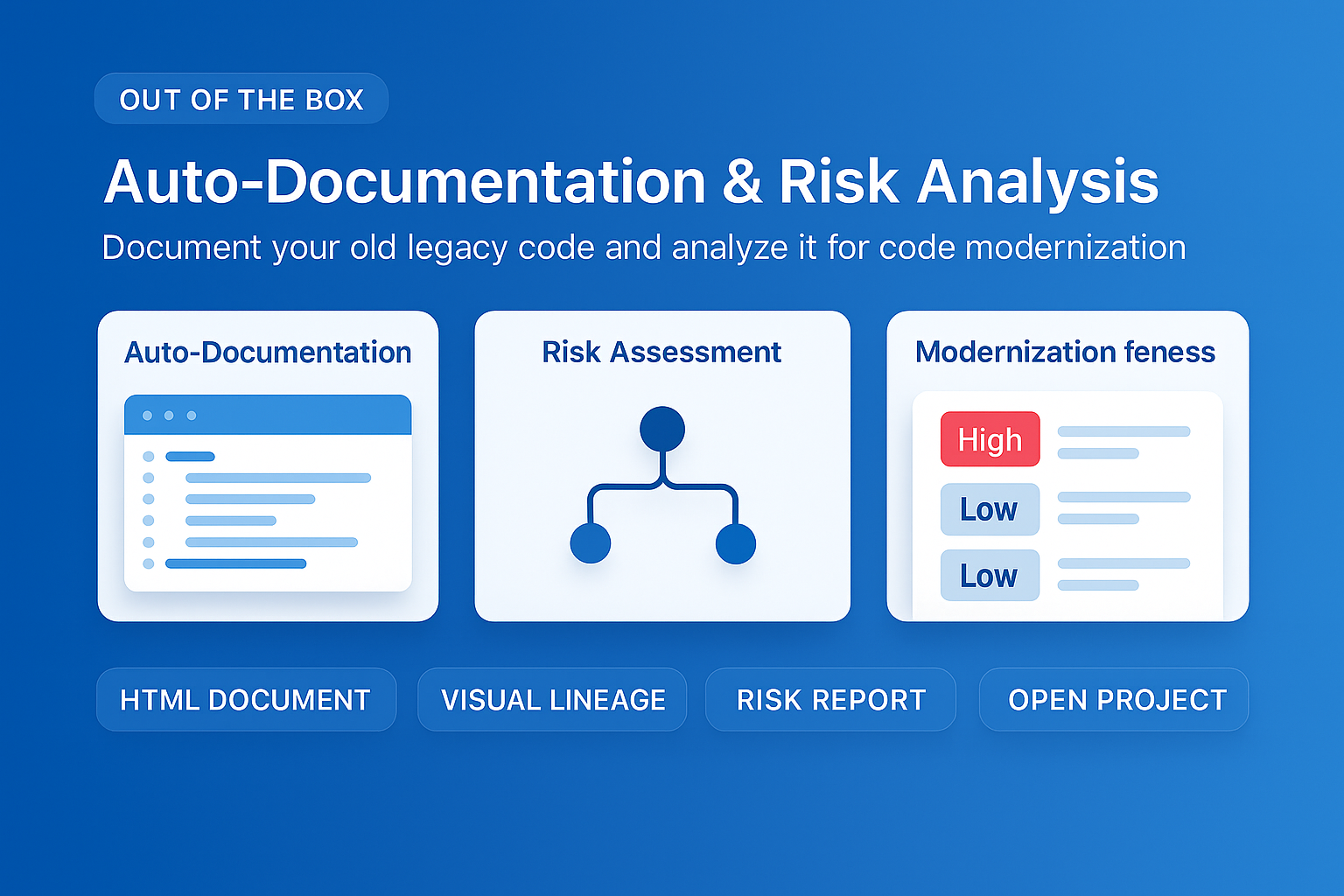
MigryX auto-documentation captures every transformation decision, creating audit-ready migration records automatically
How MigryX Handles the Hard Parts of SAS Migration
Every SAS shop has code that makes migration teams nervous — deeply nested macros that generate dynamic code, DATA step merge logic with complex BY-group processing, hash object lookups, RETAIN statements that carry state across rows, and PROC IML matrix operations. These are exactly the constructs where MigryX excels. Its combination of deterministic AST parsing and Merlin AI means even the most complex SAS patterns are converted accurately.
Recruitment and Retention Advantages
The talent dimension of ROI is frequently overlooked in financial models but is often the most strategically important factor.
Recruitment cost reduction. Hiring a SAS developer in 2025 is expensive and slow. The talent pool is small, the candidates are in high demand from organizations that have not yet migrated, and salaries reflect the scarcity. Average time-to-fill for a SAS developer role is 60 to 90 days. For a Python data scientist, it is 30 to 45 days, because the candidate pool is an order of magnitude larger.
Retention improvement. Developers want to work with modern technology. SAS developers who see no path to skill modernization leave for organizations that offer Python-based work. Migrating to Python gives your existing team a growth path and signals to potential hires that the organization invests in modern technology.
Contractor rate differential. When you need to bring in external help, SAS contractors command premium rates ($150 to $250 per hour) due to scarcity. Python contractors are available at $100 to $175 per hour with far more options for specialization. For a project requiring 1,000 contractor hours, this differential alone represents $50,000 to $75,000 in savings.
Cloud Cost Optimization
SAS was designed for on-premises deployment. Running SAS in the cloud is possible but expensive -- SAS licensing in cloud environments often costs more than on-premises, and SAS workloads tend to be inefficient in their use of cloud resources because they were designed for dedicated hardware.
Python workloads on modern cloud platforms benefit from:
- Auto-scaling. Spin up compute when jobs run, release it when they finish. SAS servers typically run 24/7 regardless of workload.
- Spot and preemptible instances. Batch Python analytics jobs can run on discounted compute instances, reducing costs by 60% to 80% for non-time-critical workloads.
- Serverless options. Functions and container-based deployments eliminate idle compute entirely.
- Storage tiering. Python reads and writes standard formats (Parquet, Delta, Iceberg) that leverage cloud-native storage tiering. SAS datasets on cloud storage incur unnecessary I/O costs.
Organizations that migrate SAS workloads to PySpark on Databricks or Python on managed cloud services typically report 40% to 60% reduction in total infrastructure costs, on top of the licensing savings.
Building Your Business Case
To construct a credible ROI model for your organization, quantify these five categories:
- Licensing elimination. Total current SAS spend, annualized, including base licenses, add-on products, and maintenance fees. This is your most defensible number because it comes directly from procurement records.
- Infrastructure optimization. Current SAS server costs minus projected Python cloud costs. Use your cloud provider's pricing calculator with realistic workload estimates. Be conservative -- assume 40% savings rather than the 60% that aggressive optimization might achieve.
- Development productivity. Number of analysts times average salary times estimated productivity improvement. Use 30% as a conservative estimate rather than the 50-60% that mature Python teams achieve.
- Talent cost reduction. Reduced recruitment costs, lower contractor rates, and improved retention. Quantify based on your historical hiring data and contractor spend.
- Opportunity value. Revenue or cost impact of capabilities that Python enables but SAS does not -- ML-driven automation, real-time analytics, integration with production systems. This is the hardest to quantify but often the largest value driver.
A conservative ROI model -- counting only licensing savings and 30% productivity improvement -- typically shows 200% to 400% three-year ROI for organizations spending $250,000 or more annually on SAS. When opportunity costs are included, the return is often 500% or higher.
The financial case is clear. The strategic case is even stronger. Migration to Python is not just a cost-reduction exercise -- it is an investment in the capabilities, talent, and technology infrastructure that will define competitive advantage in analytics for the next decade.
Why Every SAS Migration Needs MigryX
The challenges described throughout this article are exactly what MigryX was built to solve. Here is how MigryX transforms this process:
- Complete SAS coverage: MigryX handles every SAS construct — DATA steps, PROC SQL, macros, formats, hash objects, arrays, ODS, and 20+ PROCs.
- 4-8x faster than manual: What takes consulting teams months of manual conversion, MigryX accomplishes in weeks with higher accuracy.
- 60-85% cost reduction: Enterprises report dramatic cost savings compared to manual migration approaches.
- Production-ready output: MigryX generates clean, idiomatic Python, PySpark, Snowpark, or SQL — not rough drafts that need extensive rework.
MigryX combines precision AST parsing with Merlin AI to deliver 99% accurate, production-ready migration — turning what used to be a multi-year manual effort into a streamlined, validated process. See it in action.
Ready to modernize your legacy code?
See how MigryX automates migration with precision, speed, and trust.
Schedule a Demo